

How many times have you heard, “All EMRs are bad, you just have to find the one you hate the least?” Your electronic medical record (EMR) shouldn’t be pain. It should empower your teams and streamline operations. If your employees have a long list of issues with your current EMR, you’re probably using outdated or ill-fitting EMRs—and now is when to replace your behavioral health EMR.
Why behavioral health providers outgrow their EMRs
Outgrowing an EMR is a natural part of your operations. As your organization expands and the industry landscape shifts, your technology needs to adapt. You may have started with just a spreadsheet and some documents full of notes. Would that work now, when you’re managing multiple providers? The same can be said for outgrowing basic EMRs. You have options—AI assistance is here, better active and passive security is standard, and built-in connections with engagement and billing save time.
The evolving demands of modern behavioral health practices
Today’s behavioral health landscape requires more than just digital record-keeping. If you’re stuck using a generic electronic health record (EHR) built for medical practices, are you getting everything you need?
- Value-based and measurement-based care means a need for better data tracking and reporting.
- Compliance mandates, including 42 CFR Part 2 for substance use disorder (SUD) treatment, require specialized consent management.
- Retaining mental health providers is easier when your tech makes workflows less stressful and more meaningful.
To remain competitive and compliant, your tech has to support work that delivers better patient care with less hassle.
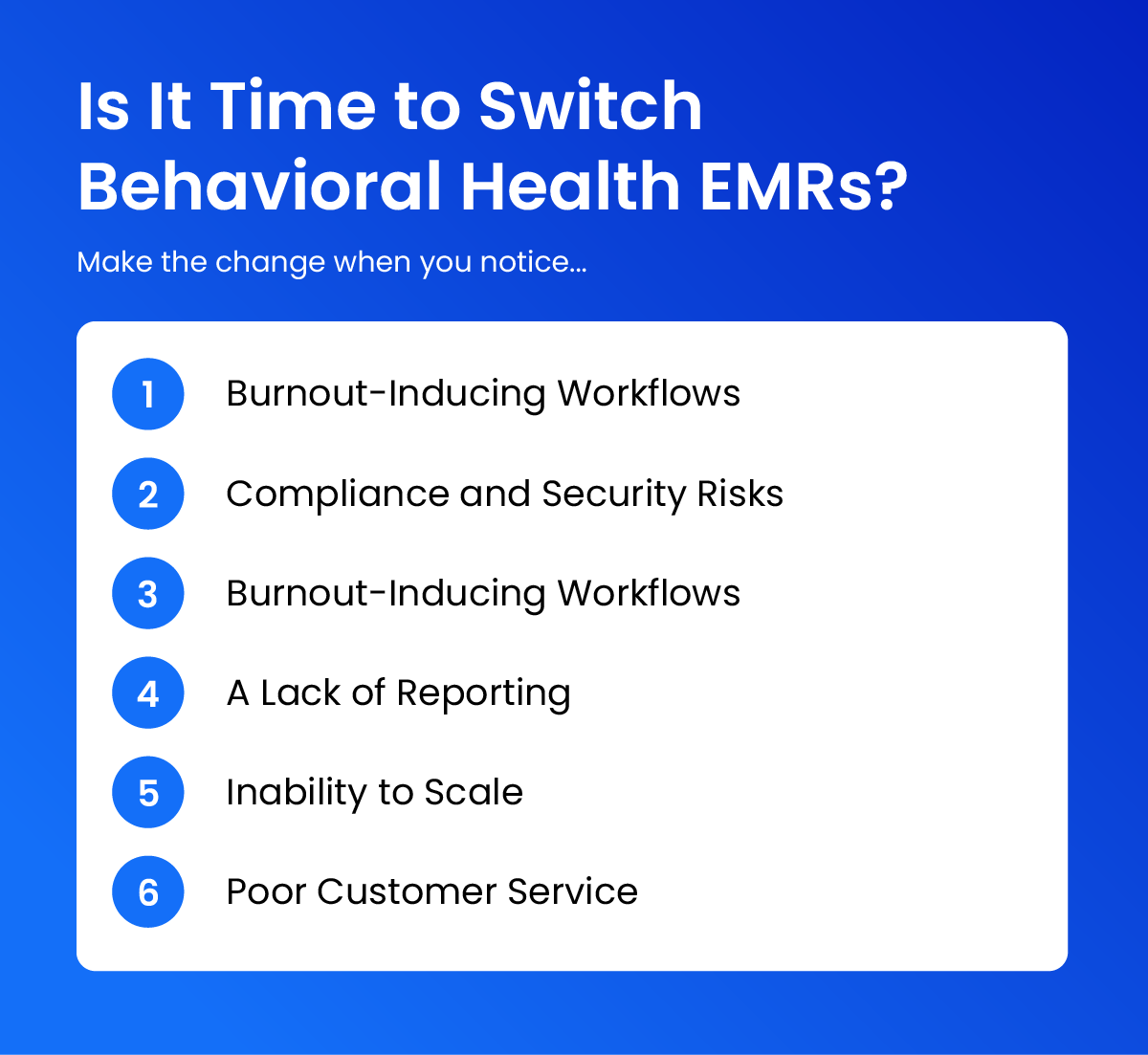
5 signs it’s time to replace your behavioral health EMR
If you’re questioning your current system’s capabilities, you are not alone. Here are five clear indicators that your EMR/EHR system is holding your practice back.
1. Inefficient workflows are causing staff burnout
Your EMR is failing when your teams spend more time on manual data entry and documentation workarounds than on patient care. Expansive charting, billing, and coding requirements do require extra time—and effort to reduce errors—but today’s landscape is full of tools that help. But admin time pulls your teams away from client care
AI-powered assistance can automate note-taking, summarize patient information, and streamline workflows, giving your team valuable time back to focus on what matters most: your patients. Plus, unified platforms connect patient engagement, EMR, and billing functions—allowing patient data to auto-populate across functions to reduce errors and save time.
2. Your system poses a compliance & security risk
Data security is non-negotiable for behavioral health treatment centers. If your current EMR platform isn’t drilling down on security, your patients’ electronic protected health information (ePHI) is left vulnerable. Outdated systems often lack access controls, audit trails, and consent requirements required for full HIPAA and 42 CFR Part 2 compliance.
Cloud-based hosting, end-to-end encryption, audit trails, and role-based access controls provide the bare minimum you need to keep your patient data secure.
3. It fails to provide actionable, data-driven insights
Your EMR is more than a digital filing cabinet for patient records, and you need to be able to use it as such. If you can’t easily track patient progress or generate reports needed for measurement-based care initiatives, your system is failing.
Easy access to census trends, bed boards, and therapy outcomes should come standard. Data is even better when it’s easy to visualize so you can quickly add them to stakeholder reports.
4. The technology can’t scale with your growth
As your organization grows, your tech stack must scale with you. EMRs can become the bottleneck that holds you back. When it’s complex, costly, or even impossible to add new users, locations, or service lines, it’s time for something better.
Desktop and mobile interfaces let teams work anywhere—including when group therapists start hosting sessions at a new site. Telehealth functions let you expand your offerings beyond in-person care. If you’re basing what your capable of on what your EMR can do, it’s time to unlock your potential.
5. Your vendor relationship is a liability, not a partnership
An EMR vendor should be a partner in your success, not a source of frustration. If you experience poor customer service with long response times for critical issues, it’s a major red flag. Hidden fees for support, training, or essential feature upgrades are another sign of a poor vendor relationship.
A true partner is committed to innovation and adapting their product for the future of your operations and the behavioral health industry. If your vendor is unresponsive or stagnant, it is time to find one who will actively support your mission.
The hidden costs of using the wrong system
Sticking with an inefficient or outdated EMR is not a cost-saving measure. In reality, the decision to delay an upgrade comes with significant hidden costs that can impact every aspect of your operations.
- Financial drain: Lost revenue adds up when you have inefficient billing processes, frequent claim denials due to documentation errors, and looming compliance fines.
- Operational drag: Staff and physician burnout becomes a recurring issue as clinicians and administrative personnel grow frustrated with inefficient tools and overwhelming workloads.
- Poor patient satisfaction: The inability to leverage data for insights means you cannot systematically improve patient outcomes, putting you at a competitive disadvantage in a value-based care landscape.
Improve your financial health, provider and patient retention, and clinical operations by switching to a unified business management platform.
What you’re missing out on
Sticking with an outdated EMR doesn’t just hold your organization back—it means missing out on transformative features that revolutionize your operations and patient care. Here’s what Sunwave Health, a unified patient care platform, brings to the table:
Cloud-based platform: Access your EMR securely from any device, anywhere. Whether your team is working remotely, across multiple locations, or on the go, a cloud-based system ensures seamless, secure access to patient data.
Built-in security:Encryption for data-at-rest and data-in-transit, role-based access, audit controls, and more keep you compliant in every action, every day.
24/7 support and custom solutions: Never feel stranded. With round-the-clock technical support and a system tailored to your operation’s unique needs, you’ll have a partner committed to your success at every step.
Staff training and knowledge base: Empower your team with hands-on training and an extensive knowledge base. From onboarding to ongoing education, your staff will feel confident and capable using the system.
One login for the entire patient journey: Manage every stage of care—from intake to alumni engagement—on a single, unified platform. Eliminate data silos and create a seamless experience for both staff and patients.
Streamlined, enjoyable workflows: Say goodbye to clunky interfaces and manual processes. Sunwave has intuitive design and AI-powered tools to automate administrative tasks, reduce errors, and save time.
Integration with third-party apps: Connect your EMR with other essential systems, ensuring smooth data flow and interoperability. This integration enhances care coordination and operational efficiency.
Automated, secure patient engagement: Keep patients engaged with automated reminders, secure messaging, and personalized outreach. These tools not only improve adherence but also enhance the overall patient experience.
How Sunwave helps you make the switch smoothly
The prospect of changing your EMR can be daunting, but it doesn’t have to disrupt your operations. Sunwave’s scalable behavioral health EMR platform is purpose-built to solve the challenges of modern providers and deliver continuous improvement. Our unified system brings together multiple systems, including EMR, CRM, and RCM functionalities, to create a single source of truth that grows with you.
We provide a dedicated implementation team to manage data migration and system configuration, ensuring continuity of care and minimizing disruption. Sunwave’s platform includes AI assistance where you need it, robust compliance features for behavioral health practices, and advanced analytics to empower data-driven decisions.
Ready to see how we compare? Talk to our team about switching EMRs.