

Optimizing your behavioral health revenue cycle management (RCM) processes keeps you in the black and serving the patients who need your expertise. A streamlined RCM process keeps you focused on what matters most: delivering high-quality patient care. But there are a lot of hurdles in the behavioral health landscape—from intricate billing codes to stringent compliance requirements. A mismanaged revenue cycle can cause claim denials, revenue leakage, and administrative bottlenecks that drain resources and hinder growth.
This guide will give you an overview of behavioral health RCM processes, from key challenges and effective strategies to the transformative impact of an integrated technology solution. Mastering your revenue cycle is a direct path to ensuring financial stability and enhancing patient outcomes.
What Is Behavioral Healthcare Revenue Cycle Management?
Revenue cycle management is the process used to manage a patient’s account from their initial appointment or intake through the final payment of their balance. It’s part of all clinical and administrative functions that contribute to the capture, management, and collection of patient service revenue. Unlike in general healthcare practices, behavioral health RCM has to clear specific hurdles, including pre-authorizations for different levels of care, distinct billing codes for services like group therapy, and adherence to stricter-than-standard privacy regulations like HIPAA and 42 CFR Part 2.
A Successful RCM Strategy for Behavioral Healthcare Businesses
Claims should be submitted accurately and promptly, denials kept to a minimum, and payments collected efficiently. Tracking financial integrity at every step allows your facility to operate sustainably and invest back into patient care.
Why Is RCM So Important?
Revenue cycle management is the backbone of a thriving behavioral health operation. Effective RCM provides a stable financial foundation from which you can deliver high-quality care, invest in staff, and scale your services to meet the needs of the patients in your community.
Value-Based Healthcare Practices
When you operate in networks with payers who incentivize value-based care, your reimbursement is directly tied to outcomes rather than claim volume. Providers must demonstrate clinical efficacy. Organizations must track key metrics and support robust reporting to maintain payer contracts and meet regulatory standards. A well-optimized revenue cycle lets you predict timely reimbursements and a healthy cash flow. But it also reduces administrative burdens on your team, improves compliance, and empowers leadership to make strategic, data-driven decisions.
Common RCM Challenges for Behavioral Health Providers
If your facility still operates on outdated platforms or manual processes, you’re probably dealing with bottlenecks, revenue leakage, and/or compliance issues. Here are some of the most common—and consequential—challenges that behavioral health organizations face:
Insurance Claims and Service Mismatch
Providing services to people without verifying their coverage is one of the easiest ways to throw a wrench into your RCM. While more people than ever have access to behavioral health coverage, they don’t always cover the services you offer—especially if their treatment plan evolves over time. If you’re lacking an up-front insurance verification process, you’re setting your operation up for denials.
Inaccurate or Incomplete Documentation
Claims are often denied based on poor documentation. If claims are submitted for services not covered by verified insurance or don’t match locations, you’re probably looking at a denial. The risks of poor documentation go up when your operation spans levels of care, state lines, and payers you work with. Depending on the size of your operation, you may have a dedicated denials management team to work through them regularly.
Billing and Coding Errors
Behavioral health billing demands an in-depth understanding of specialized codes for services such as group therapy, individual psychotherapy, and multi-level care settings. For example, incorrectly billing a group session as an individual encounter can result in a rejected claim and delayed revenue. Similarly, proving medical necessity—such as for a psychiatric admission—requires thorough supporting documentation that aligns with specific payer requirements.
State and Federal Compliance
Facilities must comply not only with HIPAA but also 42 CFR Part 2, which requires stricter consent for substance use disorder records. When role-based access isn’t enforced, staff could accidentally access sensitive SUD records without appropriate authorization, exposing your organization to audits, penalties, and reputational damage. Multi-state operators face added complexity, since every state has unique guidelines for documentation, billing, and telehealth.
Lack of Connected Systems
Disconnected systems—like standalone EMRs, CRMs, and RCM tools—create data silos and operational inefficiencies. Billing staff might manually re-enter information from paper intakes into a billing platform, introducing typos that later result in denials. Without real-time data transfer between clinical and financial systems, organizations are prone to duplicate data entry, misalignments between documentation and claims, and slow revenue cycles.
Telehealth Billing and Claim Denials
With virtual care now mainstream, behavioral health facilities must navigate a complex web of telehealth billing codes, rapidly changing regulatory guidance, and varying payer policies. For example, billing for a telehealth group therapy session without confirming payer eligibility for virtual sessions risks a denied claim and lost revenue.
Juggling Accounts Receivable and Denial Management
Increasingly, behavioral health patients are responsible for a greater share of their healthcare costs through co-pays, deductibles, or out-of-pocket payments. Behavioral health practices that have shifted to cash-only or single-carrier acceptance are operating in a different field than general healthcare practices, so they may not have the tools they need to keep their services relevant while getting enough patients in the door. If your staff is trying to manually chase down patient payments and manage denials, they’re probably spread too thin.
Strategies for Optimizing Your Revenue Cycle
You’ll need a solid strategic approach to navigate these challenges, supported by modern, seamless technology. Implementing these practices can transform your revenue cycle from a source of frustration into a streamlined, efficient engine for growth.
1. Insurance Verification and Authorization Processes
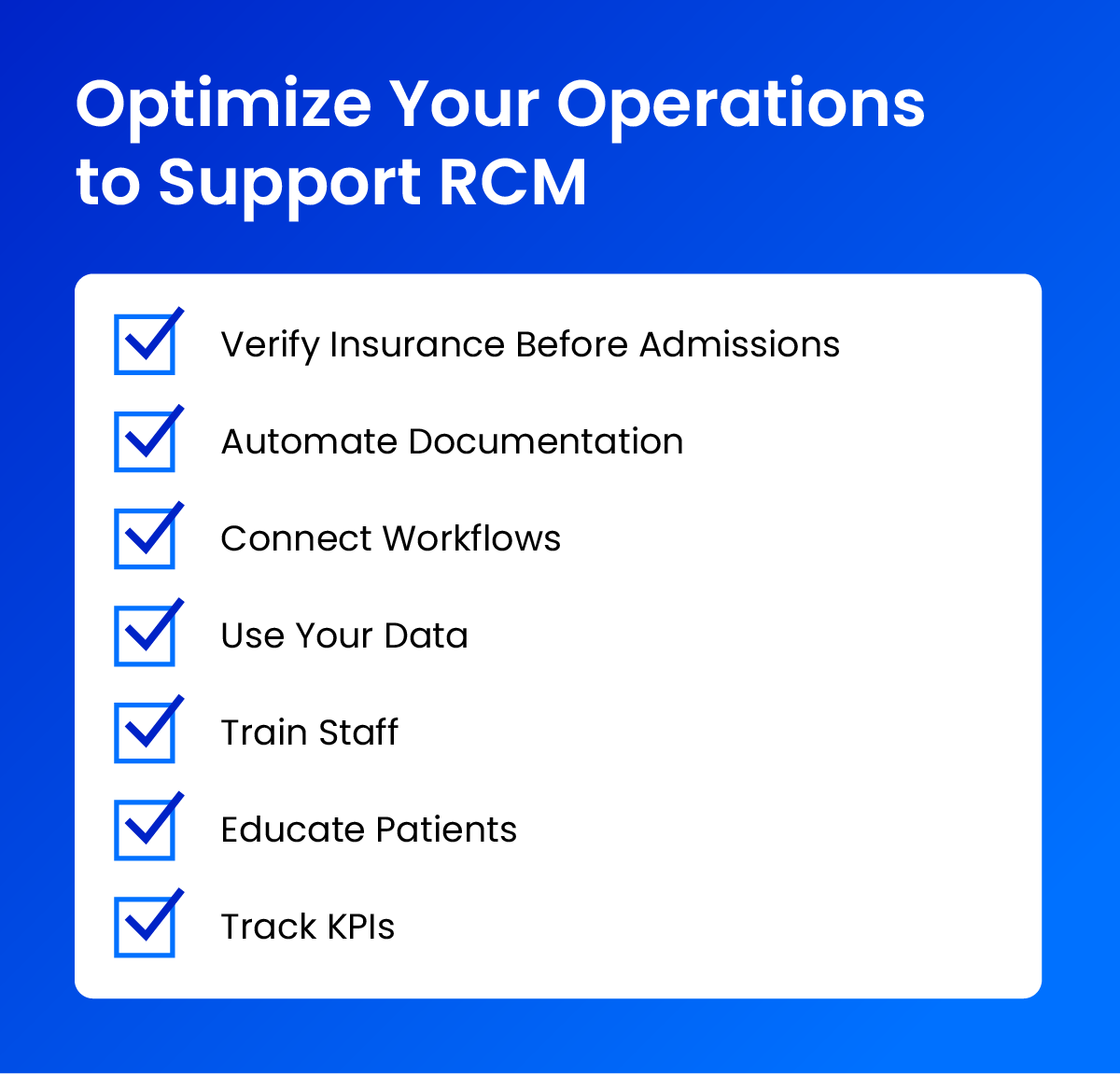
One of the most impactful things you can do to transform your RCM is to implement automatic insurance verification in your admissions process. Your system should automate insurance eligibility and benefits verification (VOB) before a patient is even admitted. Your admissions team can understand coverage limitations and patient responsibility upfront—which automatically tracks to their chart if they admit. Likewise, on-platform tools for managing pre-authorizations and concurrent reviews help ensure that services are approved and reimbursed.
2. Automate and Standardize Documentation
Leverage a business management platform that automates and standardizes your clinical documentation. Features like electronic signatures, customizable templates that update with changing compliance guidelines, and medication administration records (MAR) reduce errors and keep every chart complete and up-to-date.
3. Connect Your Clinical and Financial Workflows
A unified platform that combines your EMR, CRM, and RCM is the key to optimizing your revenue cycle. When standardized patient data is seamlessly tracked into your billing system at every step, you eliminate manual data entry and reduce the risk of errors. This automation ensures claims are accurate, ready to submit quickly, and fully supported by the necessary clinical records, drastically reducing denial rates.
4. Leverage Data Analytics for Continuous Improvement
A modern RCM system provides powerful analytics and reporting tools. Use these insights to monitor key performance indicators (KPIs) like denial rates, days in A/R, and collection rates. By identifying trends and the root causes of billing issues, you can make data-driven decisions to continuously refine your processes and improve financial performance.
5. Invest in Comprehensive Staff Training
Effective RCM starts with a well-trained team. Regularly train your billing, administrative, and clinical staff on updated RCM workflows, coding standards, and compliance requirements. Role-based training ensures each team member knows their responsibility in the revenue cycle, reducing errors at every stage. Ongoing education keeps your staff up to date with regulatory shifts and technology advances that impact reimbursement.
6. Prioritize Patient Education to Improve Collections
Patients who understand their financial responsibilities are more likely to pay promptly. Provide clear, up-front communication about coverage, co-pays, and out-of-pocket costs after completing a VOB at intake. Offer resources such as easy-to-understand billing guides, FAQs, and payment support options. Automated engagement tools, like appointment and billing reminders—and access to secure patient portals—also support a smoother collection process and minimize confusion or frustration for patients.
7. Use Technology to Regularly Monitor KPIs
Leverage advanced RCM and business intelligence platforms to track financial metrics in real time. Set up dashboards that display trending KPIs, such as clean claim rates, days sales outstanding (DSO), and denial patterns. Automate reporting and schedule routine reviews so leadership can proactively address issues, benchmark performance, and identify new opportunities for improvement. With real-time visibility, your team can respond quickly to emerging trends that impact your bottom line.
See a unified system in action—CRM, EMR, RCM—all in one place.
Choosing the Right RCM Solution
The right revenue cycle management platform, tailored to behavioral health, minimizes lost revenue and supports regulatory compliance. Here’s how to approach the evaluation process:
Must-Have Features for Behavioral Health Providers
- Seamless clinical and financial workflows: Seamless EMR/RCM platforms eliminate double-entry and ensure claim accuracy.
- Automated documentation and claims management: Tools that create clean, compliant claims and minimize manual intervention.
- Compliance management: Built-in support for HIPAA and 42 CFR Part 2, with encryption, consent tracking, audit trails, and role-based access controls.
- Advanced analytics and reporting: Customizable dashboards for real-time monitoring of KPIs and revenue trends.
- Patient engagement tools: Automated reminders, clear statements, and secure communication features to support collections and improve satisfaction.
- Scalable architecture: The ability to grow alongside your organization, supporting new programs, locations, or payment models.
- Implementation & training support: Onboarding and ongoing education resources to ensure smooth adoption.
Key Questions to Ask RCM Vendors
- Does your solution integrate with third-party platforms we rely on?
- How does your system automate compliance for behavioral health-specific regulations?
- What analytics and reporting capabilities are available for tracking denial rates and collections?
- Can you support multi-state operations and telehealth billing requirements?
- What is your process for onboarding, training, and ongoing customer support?
- How do you handle data migration from legacy systems?
Red Flags When Evaluating RCM Solutions
- Lack of behavioral health or 42 CFR Part 2 expertise.
- Limited integration capabilities requiring manual reconciliations.
- Hidden fees for support, updates, or essential features.
- Poor user interface or lack of role-based security.
- No transparent roadmap for ongoing product innovation.
The Sunwave Solution: A Unified Platform for Behavioral Health RCM
Sunwave Health is a single-platform, AI-supported solution designed specifically to solve the business management challenges of behavioral health providers. Our unified system seamlessly connects patient engagement, EMR, CRM, and RCM—no tracking down information across teams. With role-based access, the right people get the data they need without having to track it down or re-enter it.
Automate chart and form audits, receive notifications when updates are needed, and keep every claim clean and compliant from admissions through alumni programming. Our HIPAA-compliant, encrypted software makes it easy to manage consent and keep data secure. By connecting your clinical and financial operations, you’ll have less administrative workload, fewer claim denials, and more time to focus on patient care. See it in action by scheduling a demo online or calling 561.576.6037.